Ray Evans - the co-pilot
I should start this chapter with a warning. It will be one of the longer ones as I spent a good 9 years on the C130 this time round and there were many incidents worth reporting. It won’t be a day by day report, but concentrating on things that were out of the ordinary transport aircraft flying. So let’s be at it.
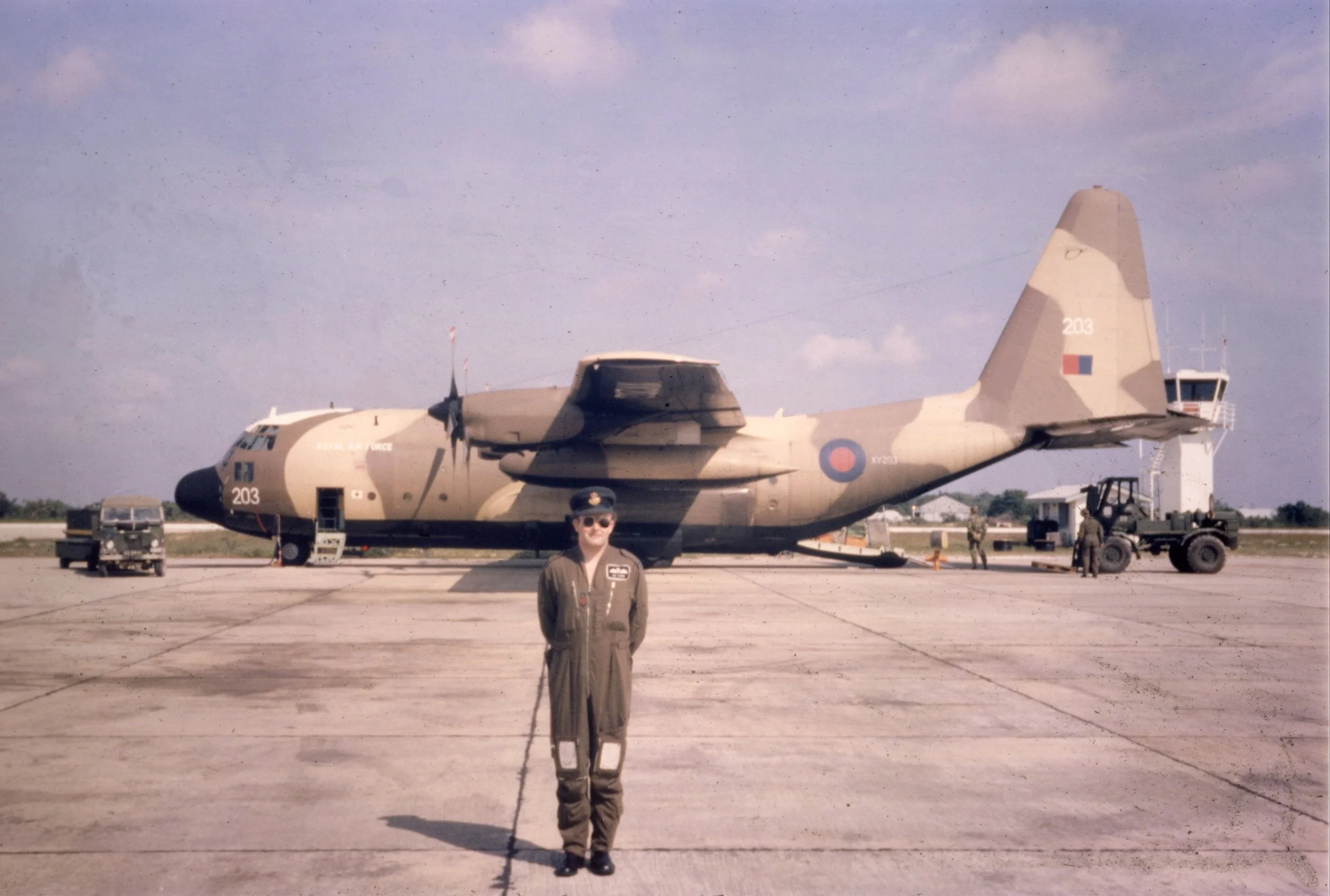
‘Youngish’ co-pilot on the pan in Belize
The first thing that happens to a new co-pilot is an assessment by the squadron’s training organisation. This is the usual “circuits and bumps” and instrument flying, followed by a route acceptance check. The first part of the checks were fine and then on to the route check. The first route I went on was with the Co-Pilot leader screening me and instructing me in the vagaries of running a flight sub-imprest system. You were issued a load of cash in various currencies according to where in the world one was going to be flying. This was before credit cards became “de rigour”. You had to account for any and every expenditure in each of the various currencies used. Jack Piercy (RIP), the co-pilot leader, explained each step.
The route was the infamous “Changi” Singapore slip, beloved of all the early Hercules crews. The route was via Cyprus, Masirah, Gan, Ceylon, Singapore, returning via the same places. Whenever we landed, Jack would go straight to Station accounts and change all the currency, Pound sterling, Omani Riyals, Ceylon rupees (which you were not supposed to export), Singapore dollars, we carried on into the next one down route and reversed the procedure on the way back. On the final leg back home Jack insisted on doing the imprest saying, “you’ll get plenty of practice on the next trip”. I did! The screen Captain was a barbary old specialist aircrew Squadron Leader called Dave Wright. He was responsible for bringing the first C130 across from America for RAF acceptance.
The trip was yet another Singapore slip. We took it in turns to make all the decisions regarding fuel load timings etc for the next leg of the trip. On the way to Gan from Masirah it was my leg and I asked the ground crew to put full fuel on board without thinking. When we got to Gan, Dave kindly pointed out without the slightest hint of sarcasm, that we still had enough fuel on board to get to Singapore the following day and carrying unnecessary fuel weight limited the aircraft performance! Somewhat chastened I learnt about flying from that. On the return leg from Cyprus to the UK, having diligently followed Jack ‘s instruction to the letter about changing all the currencies, I was having problems balancing the books. I was still supposed to be carrying out my co-pilot duties at the same time which was quite difficult and the Captain told me to sort it out on the ground. I took myself down to accounts the following day and threw my self on the mercy of the accounts Sergeant. He went through the paperwork and asked who told me to do it like that. I explained it was the co-pilot leader. “Ah he said, Mr Piercy I presume”, “yes”, I agreed. I had a surplus of something like £85 pounds which I could not explain. The Sergeant explained it was all the currency exchanges and the different rates which made the surplus. It was not illegal but not recommended as you could finish up short instead of with a surplus. “What do we do with the surplus” I asked. He suggested I divide it up amongst the crew and not to do it again! I came to hate doing flight sub imprests! There were more currency regulations to get ones head around than rules of the air! Most of the last leg home was spent sorting out imprests, not flying! Some imprests had over £8000 in various currencies to sort out, quite a responsibility considering the average cost of a house, then, was about £4500.
I did pass the route acceptance check, not due to the unexpected bonus I dished out to the crew!
The next few months were spent getting used to living out of a suitcase and learning all about the foibles of the different aircraft and all the associated problems of flying around the world. Mainly the destinations were nearly all military bases in the UK, Germany, Northern Ireland, Scotland. Other destinations were back to Masirah, Seeb, Karachi, a few trips across the Canada, Goose bay, Gander and down into American Air Force bases.
Regular runs up into Norway were where the next tale takes place. We were on run up to Bardufoss in Norway having picked up some troops from RAF St Mawgan(Cornwall). The captain was Mike Tinson who had been in my apprentice entry at Halton. Half way up Norway we started picking up an ELT (Emergency Locator Transmission) on our homing equipment. I reported this to air traffic who asked if we could assist as one of their F16 fighters lost contact, presumed crashed. Mike had a look at the fuel and said we could loiter for 2 hours and asked ATC to inform our passengers at Bardufoss we would be late and the reasons.
There was a lot of cloud around the tops of the hills but we were able to complete an accurate homing and descend (carefully!) through the cloud and there was a survivor, waving a smoke flare dancing around near his parachute. We reported this to ATC and were asked to stay on top until they could get a helicopter to him. We were able to home the helicopter in using our HF equipment and his radio compass, a procedure worked out by myself, the flight engineer, and the helicopter crew. They managed to recover the pilot. As we climbed out, ATC gave us a direct track to Bardufoss and thanked us most profusely, as did all the controllers on route. When we landed at Bardufoss to pick up our passengers, we found that they had been kept well informed and gave us a big round of applause as we went into the terminal building.
On the way back to UK, ATC were again thanking us and giving us direct routings which saved quite a lot of time on the trip. The whole crew were awarded a Strike command “Good Show” certificate for our efforts.
A few weeks later, again with Mike Tinson as the Captain, we were taking off from Lossiemouth when we flew through a flock of seagulls just after take off. Two engines immediately over temped (exceeded the temperature limit of the engine) requiring shutdown. On two engines the Hercules required special procedures to fly and land safely due to loss of hydraulic pressure and other services. We had practised this in the flight simulator so were able to land back at Lossiemouth...very quickly! One of the other engines which had kept running was found to have 4 seagulls stuck in the intake, how it kept running was a mystery to us and the engineers. Needless to say we were stuck there for a few days whilst spare engines and engineers were flown up to fix the aircraft. Claiming seniority, Mike bagged the delivery aircraft and we flew it back to Lyneham leaving the other crew to ferry our aircraft back to base after repair.
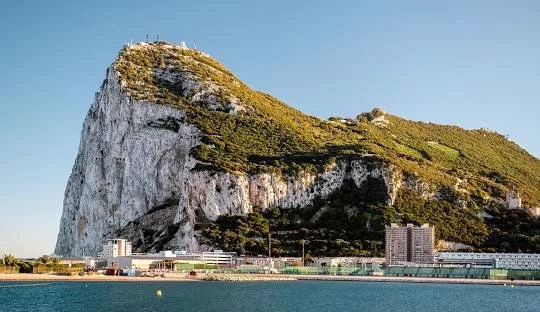
Gibraltar
One trip to Gibraltar really sticks in my memory. There was a big military exercise on Gibraltar so we were accommodated in a hotel in the town. The captain, always one for a gamble, persuaded me to go with him down to the casino. I wasn’t a big card player but remembering my experience back at Lindholme doing fire picket and losing my wages I decided I’d stick to playing blackjack, or 21 as it was sometimes called. The captain wandered off to play on one of the other tables whilst I got used to the dealer and started building up a few chips, only playing with 25p chips.
I had noticed a chap behind me was backing my play with different colour chips, not knowing the value I carried on, accumulating a few pounds worth. About half an hour later, still winning, the navigator, a wing commander came in and stood behind me, then leant forward and said,”I hope you’re not using the flight imprest Evans!”, “Of course not, I’m not that stupid, Sir!” I replied. I tried to regain my concentration but lost the next two hands so I stopped playing and gathered up my chips. The chap who had been backing my play, leant forward and put one of his chips on my meagre pile and said, “Many thanks, most enjoyable, pity that individual spoiled your concentration, would you like him dealt with?” I looked closely at him for the first time, white suit, dripping with gold rings, etc, obviously one of the local heavies, and said, “no we need him to get us back to the UK”. “Pity” he said, “many thanks” and left. The captain turned up and asked what that was all about and I won’t repeat his comment about the navigator. I went to the cashier and cashed my chips, plus the one I’d been given. I made about £30.00 all together and when I gave him the other chip I nearly died, The chap had been backing my play with £50.00 chips!! God knows what would have happened if I’d lost!! I quite liked flying with this particular captain apart from his habit of smoking long thin cheroots.
A regular part of life as Hercules aircrew was the categorisation system. New crew members came out of training as a “D” cat. This meant one needed further training and experience to become “operationally competent” as a “C” cat, able to operate successfully in all theatres. This was usually after six months on a squadron after completing the dreaded PRT (periodic refresher training). This was a mixture of ground school training and exams followed by simulator training where they throw every kind of in-flight emergency at you and then flying exercises leading to the sought after instrument rating. This allowed one to fly in any kind of weather, cloud, day and night etc, solely by using flight instruments alone. Very hard work, but worth the effort. Fortunately I did pass and was awarded my “C” category. The next grade up is a “B” cat which is above average in all aspects and last but not least the “A” cat, usually only awarded to instructors etc.
As a “C” cat I was allowed to fly into more hazardous areas, war zones etc and other high risk locations, geographic as well as weather limitations, these being higher, mainly crosswinds, and lower cloud base, down to 250 feet. The Hercules was limited to a 35 knot crosswind airframe limitation. As a “D” cat you were limited to flying in a maximum of 17 knots crosswind (note this for later in the narrative!) and a 400 foot cloud base. As a “C” cat and above you could land the beast in up to a 35 knot crosswind, hairy but doable!!
On one of our local training sorties, we were diverted off to look for a light twin-engined aircraft which had ditched in the Bristol channel. It made a change from going round and round the Lyneham circuit! We located it using our search and rescue homer and gave ATC the position. It was slightly nose down in the water with someone standing on the wing wearing a life jacket, waving. We orbited until a rescue lifeboat recovered the survivor and then flew back to Lyneham to complete our sortie!
The next trip of note was a detachment to Bahrain. All very hush hush until we got there. The only accommodation they could find for us two crews was in a hotel run by a couple of Lebanese brothers. It was brand new, not really fully operational, so I was asked to have a look at the internal radio system and PA. After a little while I managed to tune all the five receivers to different frequencies (the BBC World Service being put on Channel 1!) for the five channel selector in all the rooms and tested the PA putting this on as background. Well impressed, the brothers offered me a job on the spot! When I declined, it was replaced by free beer as long as we stayed! Not a bad reward for a couple of hours work!
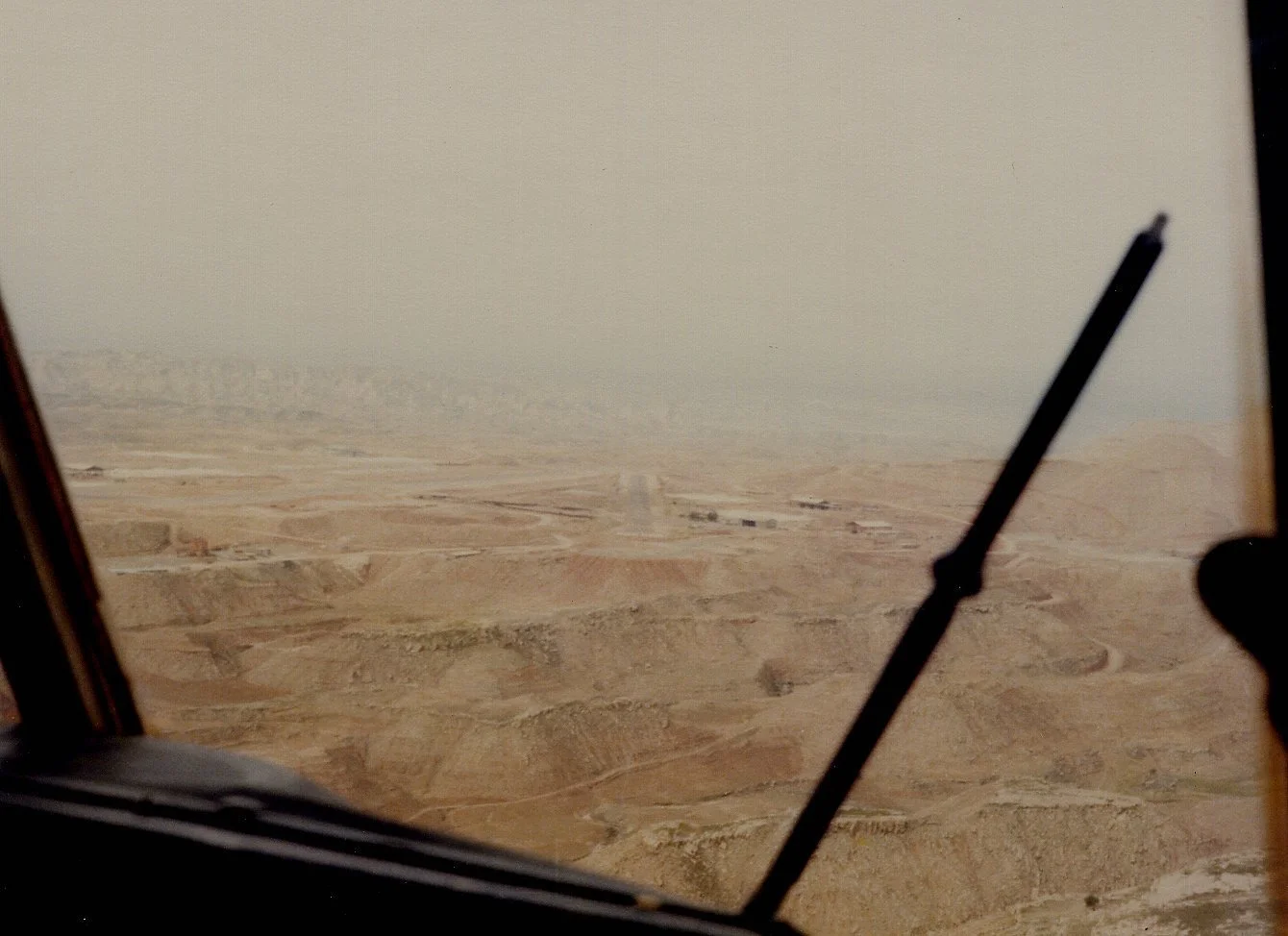
On the approach to Majeid Sulieman in Iran to evacuate British Nationals
The Captain, Andy Potter, and I, together with the navigator and the other crew were taken down to the British Embassy for a briefing on what we were doing there. It turned out we were to evacuate British nationals from various airfields and air strips around Iran, whilst the country was in turmoil from the Shah’s deposition by the Ayatollah Homeini. We were issued with 9mm pistols and ammunition for our own protection and only to be used in self defence!. The brief was very basic, a list of airfields and times to be there, and if they were waving, land and pick them up, if they were pointing anything that looked like guns...leg it! The first run was to an airfield called Majeid Sulieman to pick up 50 plus adults and dependants. We departed Bahrain climbed to 10,000 feet and headed for the Iranian border.
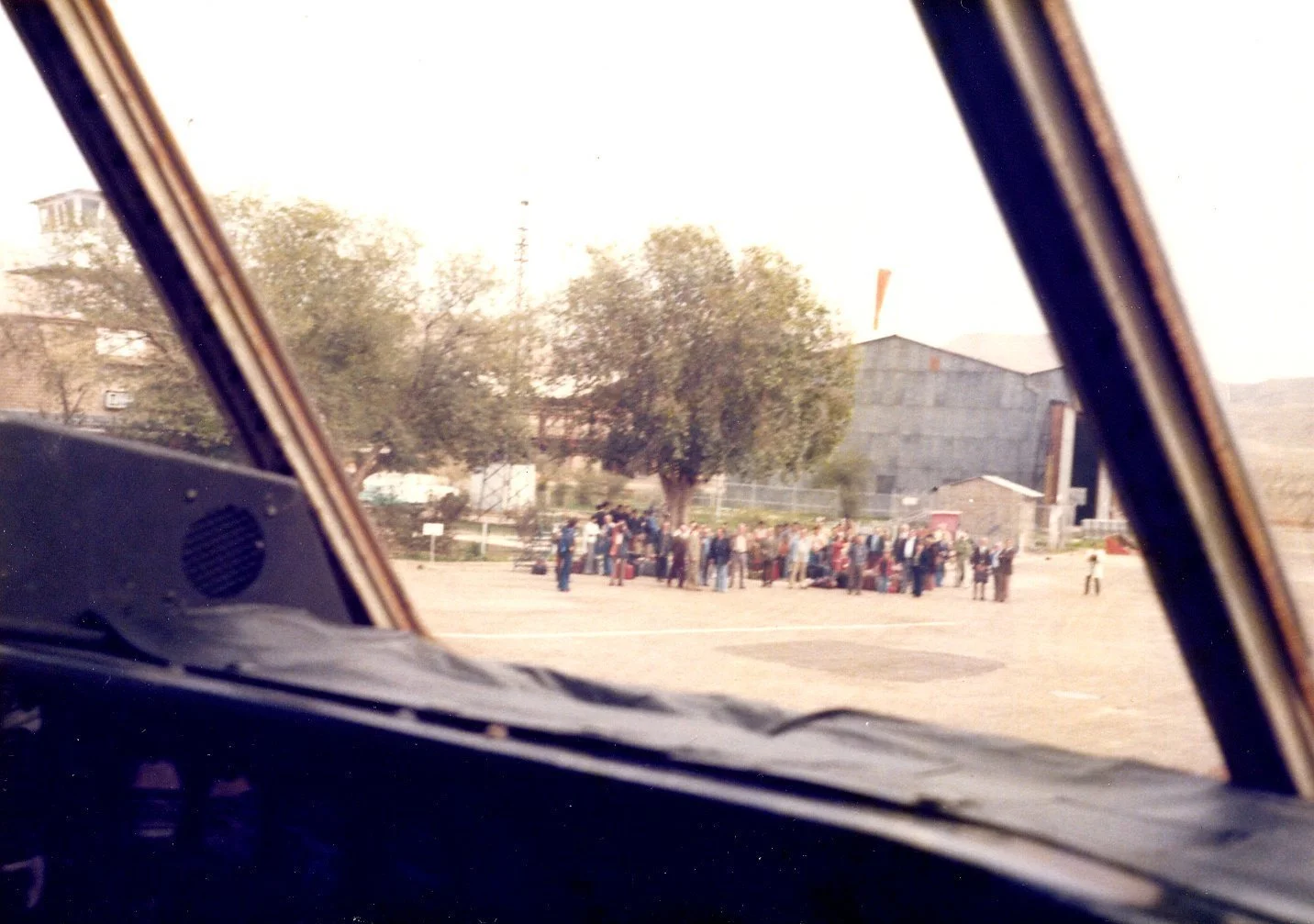
A group of passengers waiting for us at Majeid Sulieman
As we crossed the border we dropped down to 500 feet to avoid their radar. After an hour we saw the airfield and sure enough there were people waving. As we landed a very British voice came over the radio telling us to get a move on as there were “technicals” heading our way. (technicals were Land Rover type vehicles, with guns and cannons mounted on them). The passengers were hustled on board and we took off smartly, staying low level until we hit the Bahrain border, climbed up to 10,000 feet and called for landing clearance. Then the fun started. One of the children on board had smuggled a parrot in their luggage which made itself known to customs and a couple of other passengers had dual nationality causing a few problems!. We left the Defence attaché to sort this out and went through the crew exit setting off all kinds of alarms. Security rushed over and of course we were all carrying 9mm pistols! It was then decided we would leave the pistols on the aircraft in a locked safe whilst we were in Bahrain! We had noticed that we were losing liquid oxygen during the flight and there wasn’t any liquid oxygen in Bahrain so had a quick shuttle down to Thumwrait in Oman to pick some up. This proved to be an ongoing problem, which however meant we did not miss a ground meal entitlement to our allowances, every day!
Next day, off to Ahwaz via Thumwrait another load of ex-pats, again a British voice on the radio giving us passenger details. This was quite a large regional airport which was completely deserted apart from ourselves. No problems with customs this time back at Bahrain. I had word during this detachment that one of our other squadron crews was on its way through from the Far East having been away for six weeks and I knew it was coming up to a friend of mine, the Loadmaster, Bert Desmond’s, birthday. I arranged a cake with our Lebanese hosts and got both crews organised to meet up at their other restaurant as a prearranged treat. Great fun especially when the cake was wheeled in after the main course to the usual song!. “I’ll get you Evans,” Bert said! He did too, several years later as a Hercules Captain, it was just coming past midnight after we had taken off from Gander, Newfoundland, the night before my birthday. There was a nudge on my left shoulder, Bert was there with a plate of apple pie and ice cream with a lit candle stuck in it!
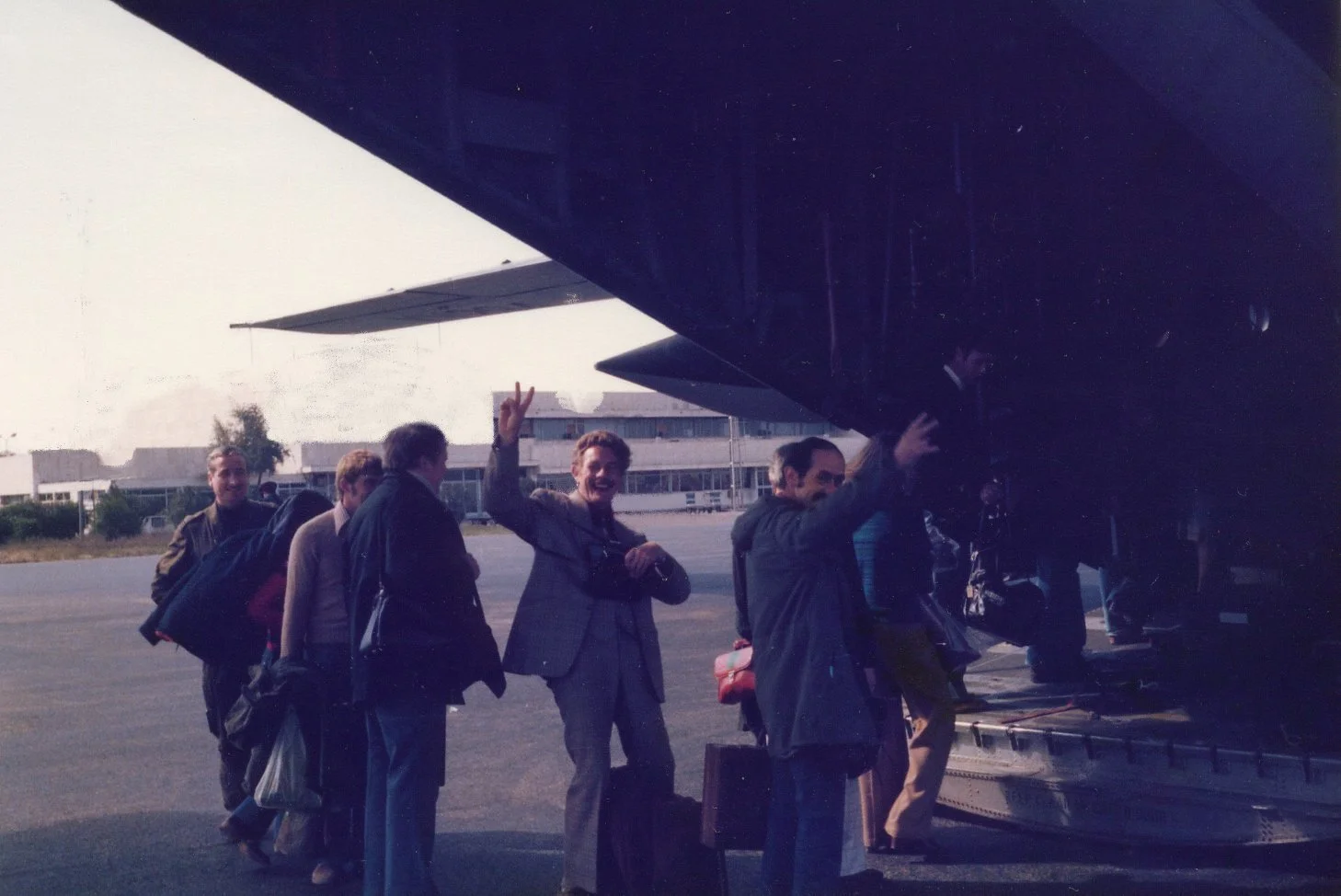
Some very happy expats!
The day after the birthday party, the hotel had run out of beer, so Bert suggested we get a taxi out to the American navy base at Dufair. We were allowed onto the base by showing our ID cards and went to the base exchange store to buy our beer. The cashier suggested it would be better to buy the beer in the recreation hall around the corner. As we waited at the counter Bert spotted a row of dartboards across one wall of the room. Bert said, “Fancy a game Ray”, “Of course” was the reply. We were playing a standard UK game of 301, double off, double finish much to the surprise of some navy personnel who gathered to watch us, then challenged us to a match, several games later, and several beers I might add, we hadn’t lost a game and the stakes were upped to a case of beer instead of a round of drinks each game! Still we could not lose even though several more beers had been drunk. Eventually a senior petty officer came up to find out what the uproar was all about and threw us out, fortunately with our winnings, eight cases of beer! Back to the hotel feeling no pain, for another party to celebrate our winnings!.
Our last trip out of Bahrain into Iran was a real classic gotcha! The briefing was that we had to land at Tehran international on the parallel taxiway to the perimeter fence and be there at a specific time with the ramp and door open at the rear of the aircraft. How we got there was left to our initiative! After looking at the airfield plan we decided we would overfly the airfield at 5000, feet declare an emergency and land with one engine shut down ready for a quick restart. Our brief was that the airfield was in the hands of the cultural revolutionaries but it was still open, after a fashion. We got airborne and giving my best impression of a panicking pilot landed, despite Air traffic shouting repeatedly on the radio, “the airfield is closed”, on the parallel taxy way. After turning around and restarting the engine the load master shouted the fence is down and about 25 scruffy, smelly, Arabian dressed individuals rushed on board. One of them came up onto the flight deck and said, in a very familiar English voice,“better get moving as there are a couple of technicals on the way!” His exact words were somewhat more succinct! After a very short take off roll we got airborne and departed low level and I could see the vehicles running down the taxiway after us as we turned away! The guys we had picked up were obviously the special forces types who had been collecting and moving the ex-pats to our pickup points. Once we were airborne, the first thing they asked was,”got any food mate?” We had the usual sandwich boxes and the loadmaster said he thought that they would eat the boxes as well, the food disappeared so quickly! Yet another party that night as the SF (Special Forces) guys were staying in the same hotel.
Another detachment to Masirah, on one resupply run from Masirah down to Salalah, the captain decided to go low level for a change as we had been briefed that the uprising with the Yemeni rebels was over. We had an Omani army captain on the flight deck and as we came across the top of the Jebel at 500 feet he started leaping up and down and shouted “climb, climb”. When we queried this he said although the main rebels had surrendered there were still active Sam7( Russian Surface to Air Missile) sites near the airfield, where the rebels were still in control. Previously our normal approach into Salalah was to come at over 7000 feet(the maximum range of a SAM7) and spiral down in a very steep turning descent to avoid being targeted!
On the outbound trip we were tasked to go via Seeb and an Omani Air force Captain asked the load master if he could have a word with the Captain. He explained that he was the pilot of a Skyvan aircraft en route to Seeb with the body of a dead casualty, in a body bag, which was leaking and a bit aromatic. It would take him three hours in his unpressurised hot aircraft at 5000 feet as opposed to our one hour at high altitude and if the body was stored on the ramp it would chill down and be less of a hazard! It’s worth several cases of beer he said. How could we refuse? He organised all the facilities at Seeb and we were met by an ambulance whose crew were also pleased the body had been chilled down!! Back to Masirah and New Year’s Eve celebrations. One of the resident detachment C130 crews duties that night was to go around all the ground crew and permanent staff accommodation and judge the decorations. Some rooms had really gone to town, a pirate’s galleon, Star Trek Enterprise flight deck, wild west saloon were just some of the efforts. The idea was to ply the aircrew with much drink to get the best marks...of course we were totally impartial... with the wild west saloon winning hands down due to the presence of dancing “girls”. (Masirah was an all male detachment!) I must also mention here, one of the perks of Masirah was being able to bring home some rather large crayfish tails, more like lobsters which we used to swap with our local butcher for venison fillets! We could buy these from the bar before leaving and they were delivered to the aircraft just before leaving.