Tristan da where?!?
Some of you may remember a rather nasty outbreak of a disease called Hantavirus in May 2026 on a small cruise ship, The M/V Hondius. If not, you can find out more here.
Anyway, 30 Sqn were involved in a part of this incident, and quite dramatic it was too.
Flt Lt Jamie Faed, who was on the trip, tells the story below… As always, please feel free to leave a comment below:
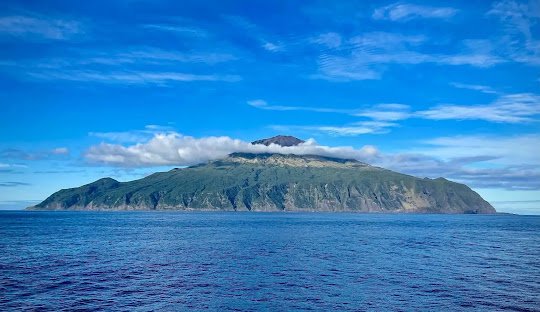
Tristan da Cunha
On 7 May 2026, during what began as an ostensibly routine training day, 30 Squadron was tasked to assess the feasibility of conducting an aerial delivery of parachutists and life-saving medical equipment to Tristan da Cunha—the most remote overseas British territory, located approximately 1,800nm south of Ascension Island and 1,500nm west of Cape Town. The mission aim was clear and urgent: deliver critical medical support to a patient suffering from a suspected Hantavirus infection, whose survival was contingent upon the rapid provision of oxygen and specialist care.
A frenetic but highly focused day of planning followed. The resulting scheme of manoeuvre required deployment to Ascension Island under a no-fail AAR bracket, a minimum crew rest period, and then an extended duty day featuring a second no-fail AAR bracket to enable the execution of a High Altitude Parachute (HAP) insertion followed by delivery of 3.3 tonnes of CDS and two harness packs—all in winds approaching operational limits.
On 8 May, three A400M crews from 30 Sqn deployed accompanied with a 30 Sqn Ops Assistant and 2 Engineers from LXX Sqn. Following a minor but character-building delay involving RAF Brize Norton Movements, and an interpretive approach to load/passenger clarity, the aircraft departed just over an hour late, placing immediate emphasis on time, weather, and execution discipline.
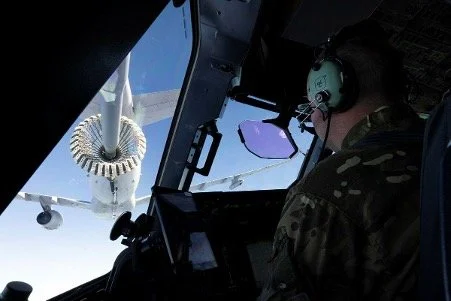
On our way!
Approximately four hours into the 10-hour sortie, the first crew conducted an exemplary AAR serial with a Voyager (10/101 Sqn) requiring only a single contact—an efficiency not universally achieved but widely admired. Concurrently, crew 2 refined the following day’s fuel and airdrop plan in-flight demonstrating the flexibility and ingenuity expected of deployed Atlas operations.
Upon arrival at Ascension Island, the crew were greeted by Movements staff and a briefing on a number of island rules, including a strict drinking policy—somewhat academic given the bar had already closed. After some additional (and entirely expected) communications friction, the crew secured accommodation. Meanwhile, overnight, one of the loadmasters and a 47 Air Despatch team re-rigged the entire airdrop load to meet an unbriefed, somewhat nugatory, sequencing requirement. With eight hours available and eight hours of work required, the team delivered precisely on time—a recurring theme throughout the operation.
Following mandatory crew rest, the crews reported at 1030Z. At approximately 1100Z, OC 2 Flt confirmed clearance following the 11 Group CAG: Greenlight.
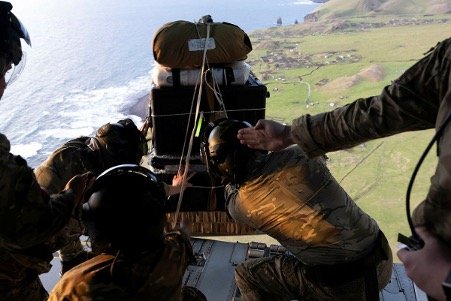
Red on!
At 1200Z, the crew departed Ascension Island for Tristan da Cunha. Sunset at destination was 1755Z, driving a tight timeline.
Three hours into the sortie, Crew 1 conducted a second AAR serial to enable arrival at maximum safe drop weight and retain diversion fuel to Cape Town. Once again requiring only a single attempt to complete the job. Control then passed to Crew 2 for the tactical phase.
First radio contact with Tristan was established at approximately 1600Z. Weather conditions matched forecasts with notable precision. Following a wind-find descent, the aircraft repositioned for a crosswind release.
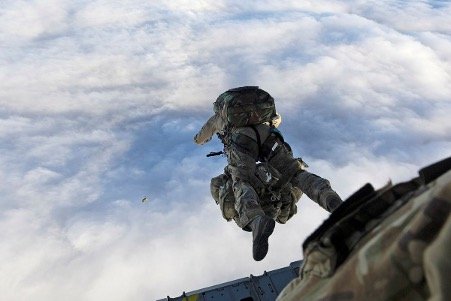
Green on!
At 1645Z, the HAP serial commenced: four parachutists exited on BT80s, followed ten minutes later by two tandem pairs carrying the doctor and ICU nurse on BT533s. All landed safely. Subsequent reporting described the insertion as “technically tricky”.
A hand-swap in the cockpit and a rapid cargo hold re-role followed. The ALMs executed an impressively swift transition from HAAD to CDS—no small task under operational pressure. After a dry clearance pass over ‘Potato Patches DZ’, the crew flew a profile to deliver the CDS drop at 850 ft AGL. Six minutes later the first harness pack was delivered from 500ft AGL, followed four minutes later by the final harness pack.
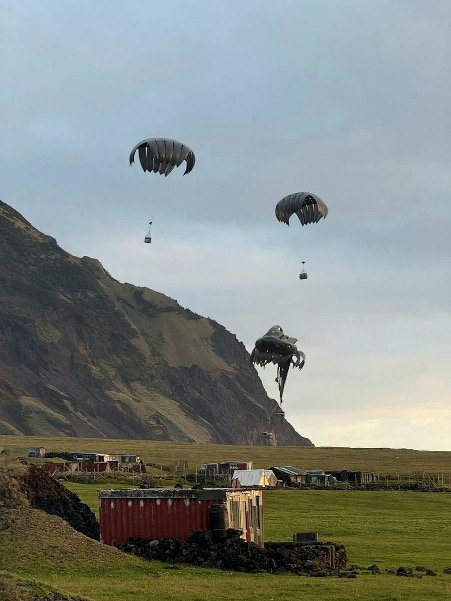
BANG ON!
During climb-out, the Island Administrator transmitted heartfelt thanks for the delivery. After observing a picturesque sunset (timing finally in the crew’s favour), control reverted to Crew 1 for the recovery to Ascension. Total sortie duration: 10 hours 10 minutes.
On arrival, the crew were met by the deployed support team, who had arranged appropriate refreshments. The island’s drinking policy was, in the interest of operational morale, tactically disregarded.
The following day, Crew 3 repositioned the aircraft to Gibraltar, where an additional night stop was required due to a runway embargo at RAF Brize Norton. The crew returned to Brize on 11 May, concluding what can only be described as a unique and highly demanding operation.
The tasking is assessed as the first ever tandem parachute insertion of medical personnel, as well as the longest-range aerial delivery mission conducted in recent memory—and certainly on the A400M.
The patient is reported to be recovering well. The recovery plan for the parachutists remains under naval development.