The Battle of Crete - 30 and 33 Squadron
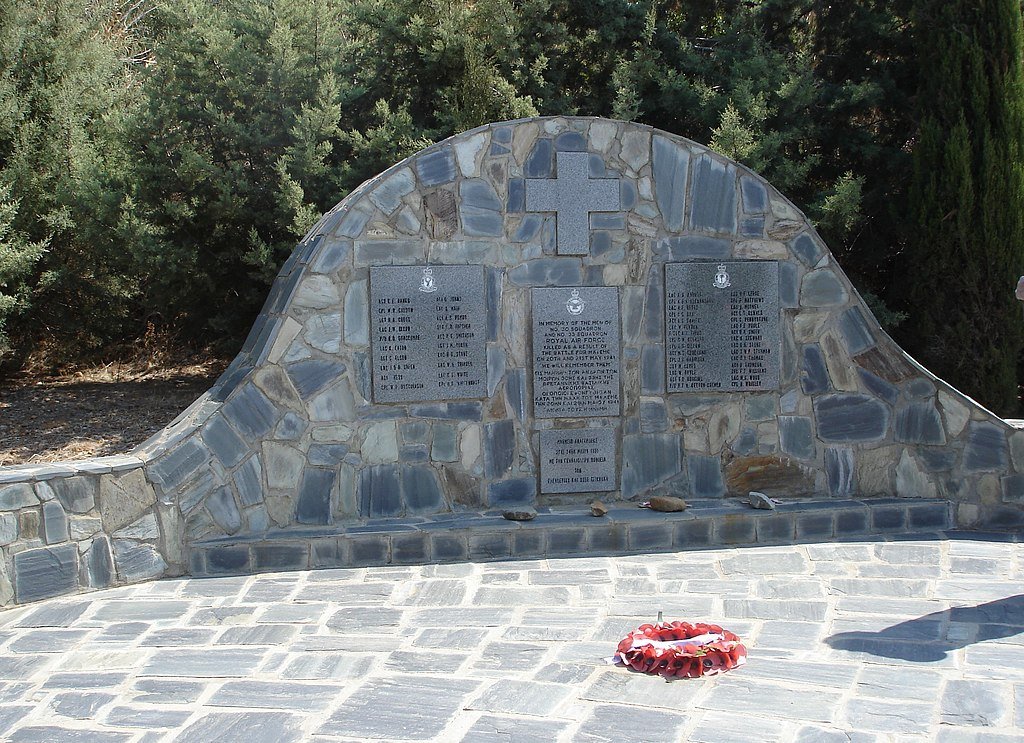
Maleme Memorial on Crete
Please note that all picture are sourced from 30 and 33 Sqn archives, IWM and local Cretan web sources.
Retreat from Greece
1. By the end of October 1940, with the Battle of Britain over and the Blitz against Britain about to begin, the Italian Fascist dictator Benito Mussolini, having commenced the Greco-Italian War by invading Greece from Albania on 28 October, chose to ignore military doctrine of ‘never split your forces’ and having invaded Egypt from Libya, Italian troops were able to advance 60 miles into Egypt as Mussolini, desperate to establish credibility with Adolf Hitler, watched German forces rapidly advancing through the Balkans.
2. As Churchill’s last unconquered ally in Europe, Greece had been given his solemn guarantee of military support in the event of any invasion. This led to the steady build-up of the natural anchorage at Souda Bay by the Royal Navy and Allied troops, which released the 5th Cretan Division to move up to the Northwest of Greece, where they were to fight with their legendary valour and ferocity. Feeling his promise keenly, Churchill ordered General Wavell, General Officer Commanding Middle East (GOC ME) in Cairo, to reduce his thinly spread forces across the Middle East theatre and dispatch an Expeditionary Force to Greece. Reluctantly Wavell did as he was ordered and ‘W’ Force, comprising 65 000 British, Australian and New Zealand troops under Lieutenant General Sir Henry Maitland Wilson, left North Africa for Greece.
3. One of the first RAF squadrons to deploy to Greece was 30 Squadron, with their Blenheim Mk1 light bombers and Mk1F fighters. Arriving at Eleusis near Athens on 3 November 1940, the squadron conducted its first offensive bombing raid against Italian shipping in and around Valona (Vlorë) in Albania on 6 November. Deployed to unprepared fields across Greece alongside 211 Squadron (Blenheims) and 80 Squadron (Gladiators/ Hurricane Mk1), these RAF units, along with 805NAS Swordfish from Maleme in Crete, carried out operations throughout the Winter, often in appalling conditions, alongside the Greek Air Force. In January and February 1941, the small Allied air force was joined by 11 Squadron (Blenheims), 112 Squadron (Gladiators) and sixteen Hurricane Mk1s from 33 Squadron, which arrived at Eleusis on 19 February.
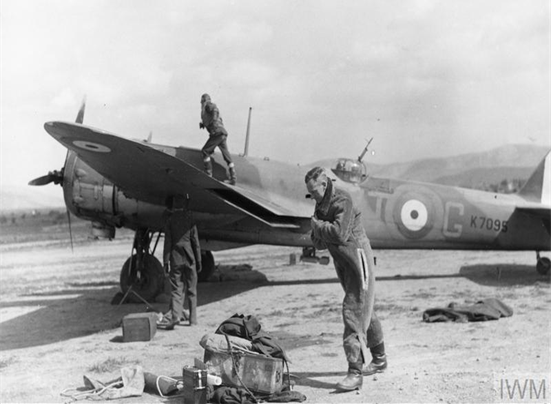
30 Sqn Blenheim in Greece, sadly lost on 11 Apr 1941
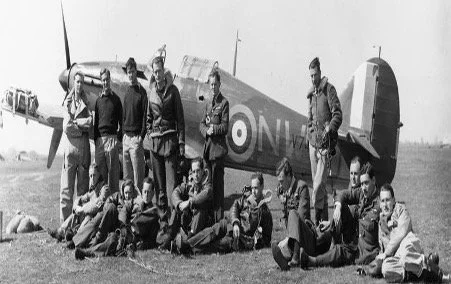
33 Sqn in front of one of their Hurricanes
4. In North Africa the British and Commonwealth troops had pushed the Italians back to Libya, while the Greeks had stopped them dead in their tracks in the Pindus mountains. Hitler quickly realised that he would have to use his German forces to bolster his beleaguered ally if victory was to be achieved, especially as he needed Greece suppressed and the Balkans secured to protect the Southern flank of his long-planned invasion of Russia. Hitler’s error was in not recognising what the historian Antony Beevor calls “the Italian regime’s talent for disaster”.
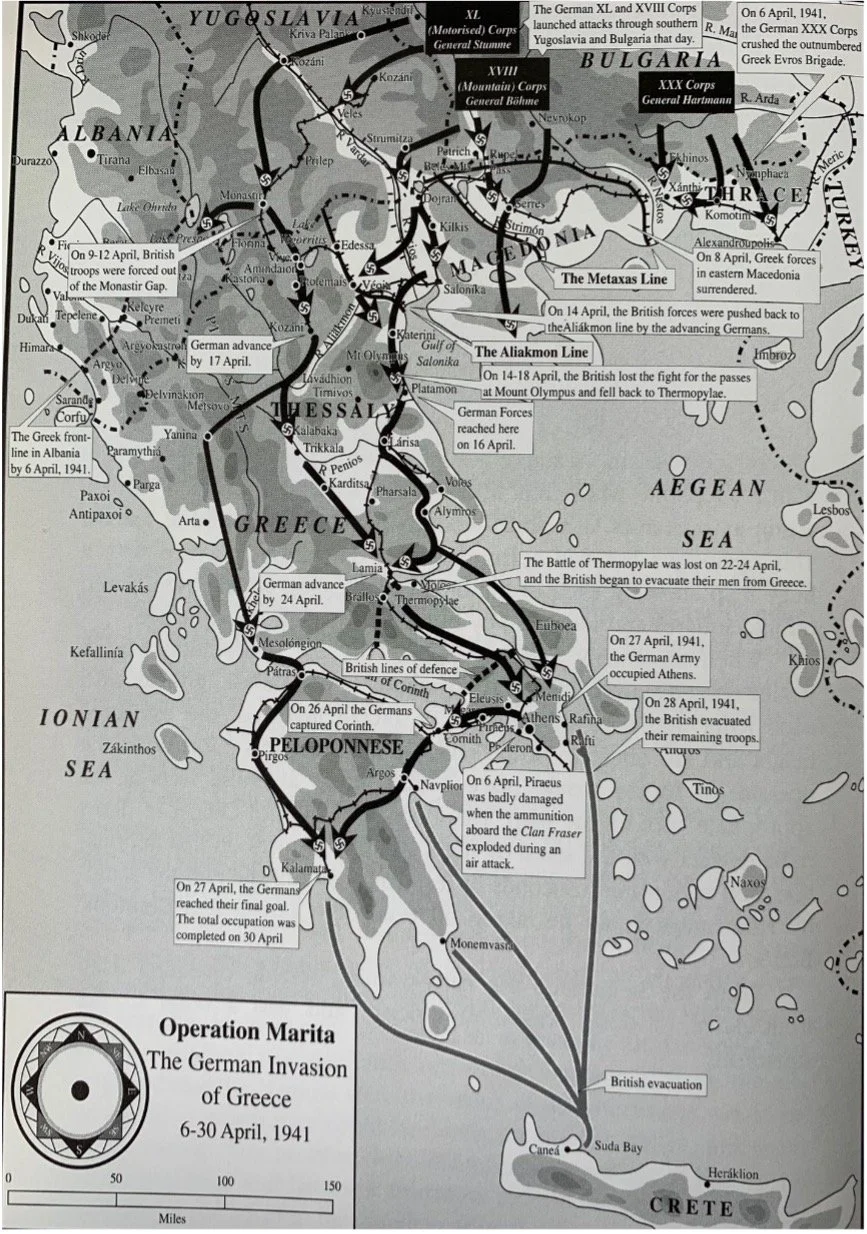
5. Hitler launched his Greek invasion - Operation Marita - on 6 April 1941, and once again the overwhelming German ‘Blitzkrieg’ approach resulted in a rapid Allied retreat. By the end of the month, Greece was being evacuated with German troops entering Athens on 27 April. Most unfortunately for Crete, their sons were cutoff by that advance and taken prisoner. Many more were cut off when elite German parachute troops – Fallschirmjäger - attacked the bridge over the Corinth Canal. With some unbelievably accurate Bofors gun fire, two brave Engineer Officers managed to explode the pre-laid charges but, even as they blew the bridge, they condemned everyone North of it to become Prisoners of War (bar a small few who evaded with wonderful and courageous local support).
6. Allied losses in Greece were devastating, although the 2,000 killed was, perhaps, fewer than might have been anticipated; the Greek loss of life was far higher. Some 14,000 allied troops became POWs but around 25,000 men were evacuated by the Royal Navy to Crete while 24,000 were evacuated straight to Egypt. However, the campaign also cost the allies around 100 tanks, 400 artillery pieces, 8,000 vehicles and almost all communications equipment. In the face of overwhelming air superiority, the RAF lost over 200 much needed aircraft. By way of contrast, the British Army of 2026 has a total maximum strength of 108,000 and (on paper) 213 tanks, while the RAF only has around 150 fighting aircraft.
7. A mere eight Hurricanes and fourteen Blenheims escaped from Greece to Maleme on Crete from 17 April. In his book ‘Escape to Live’ the commanding officer of 33 Squadron, Squadron Leader Edward Howell, noted that the Blenheims were “clapped out” and, given that both Squadrons had been fighting for months, his own fighters were probably looking a little tired by then as well! Nonetheless, those “clapped out” aircraft immediately turned around and spent the next few weeks covering the evacuation shipping, with 30 Squadron notably exploring just how many people could be fitted into a 3-seater bomber and evacuated to safety. Apparently, the record was 11 passengers, begging the question of just how it ever took off?! At Maleme 33 and 80 Squadrons combined to become the ‘HurriForce Crete’ and were in daily combat against the Luftwaffe. Several Fleet Air Arm aircraft had been stationed at Maleme, alongside several damaged and unserviceable others, and the RAF’s arrival allowed the airworthy (but basically obsolete) aeroplanes to be flown out to Egypt.
8. Air operations in May 1941 proved costly against the sheer numbers of Luftwaffe fighters, and replacement aircraft from Egypt were sometimes shot down even on their delivery flights. One Hurricane fell to our own Bofors guns at Maleme, costing the pilot his life. By 19 May, when Group Captain Beamish, the senior RAF Officer on Crete, ordered all aircraft to leave for Egypt, knowingly leaving the island with no air cover, a mere four Blenheims and one solitary Hurricane departed from Maleme airfield. On 19 May, 30 and 33 Squadrons became non-operational, and 229 Officers and men were left behind to fight a soldier’s battle and fill a soldier’s role as best they could.
The German Plan
9. The Germans named the invasion of Crete ‘Unternehmen Merkur’ - Operation Mercury. It was the first ever attempt at assaulting a strategic target by airborne forces alone and was the audacious brainchild of Luftwaffe Generalmajor Kurt Student, architect of the operation to capture Fort Ében-Émael in May 1940. As their ‘champion’, Student had convinced Hitler, despite massive Wehrmacht opposition, that his Luftwaffe Airborne Forces could achieve success. The storming of the bridge over the Corinth Canal had clearly demonstrated his troops’ tactical ability and, given that the Royal Navy enjoyed surface supremacy in the area, the shortage of ships and barges meant the chances of a successful seaborne invasion of Crete were small.
10. Student’s plan was straightforward: after heavy bombing and strafing had suppressed the anti-aircraft guns, about 25 gliders carrying airborne assault troops would land in and near the Tavronitis River that ran northwards, along the western side of Maleme airfield. Commanded by Major Franz Braun, this force would seize control of the iron bridge over the river. Closer to the river mouth, a further 16 gliders led by Oberleutnant Wulff von Plessen would attack the airfield and suppress the remaining Bofors guns. A third group led by Major Walter Koch would land directly on the slopes of Kavkazia Hill which dominates the airfield and assail that (‘Hill 107’ in military parlance, indicating it reaches 107 metres above sea level).
11. Further landings in a comparatively safe area slightly further west of the Tavronitis Bridge were planned for a larger wave of 2,000 glider borne and parachute troops, tasked with crossing the river - hence, Braun’s task of capturing the bridge intact – and then join the assault on the airfield and the hill. With the airfield defences suppressed and Kavkazia Hill in German hands, air landings at the airfield could commence, delivering 12,000 troops of the 5th Mountain Division, with logistics and heavy equipment to relieve the 4,000 airborne forces Student committed to the taking of Maleme.
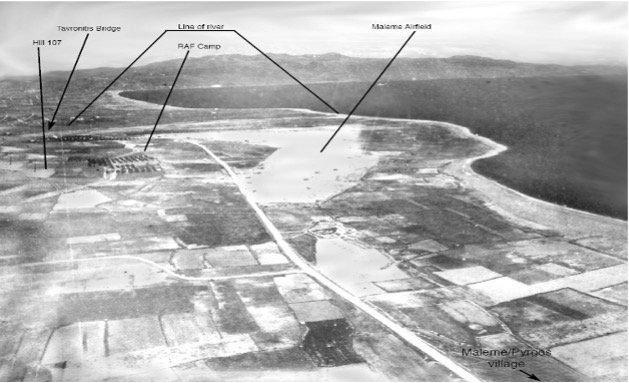
Maleme airfield in 1941 viewed from the East
12. A total of 11,000 Fallschirmjäger dropped on 20 May 1941, with the other 7,000 landing slightly East of Maleme, targeting Chania and Souda Bay; in subsequent waves on that first day, yet more dropped onto Rethymno and Heraklion. Subsequently, a seaborne flotilla of commandeered vessels was expected to bring heavy equipment and further Mountain Division reinforcements to secured German landing areas on the island later that evening.
13. The Allied defence plan was equally straightforward. At Maleme, New Zealand troops were to prevent the capture of Maleme airfield at all costs. In the centre, Australians would hold Rethymno and in the East, the British would defend Heraklion. The Royal Navy would annihilate any surface vessels.
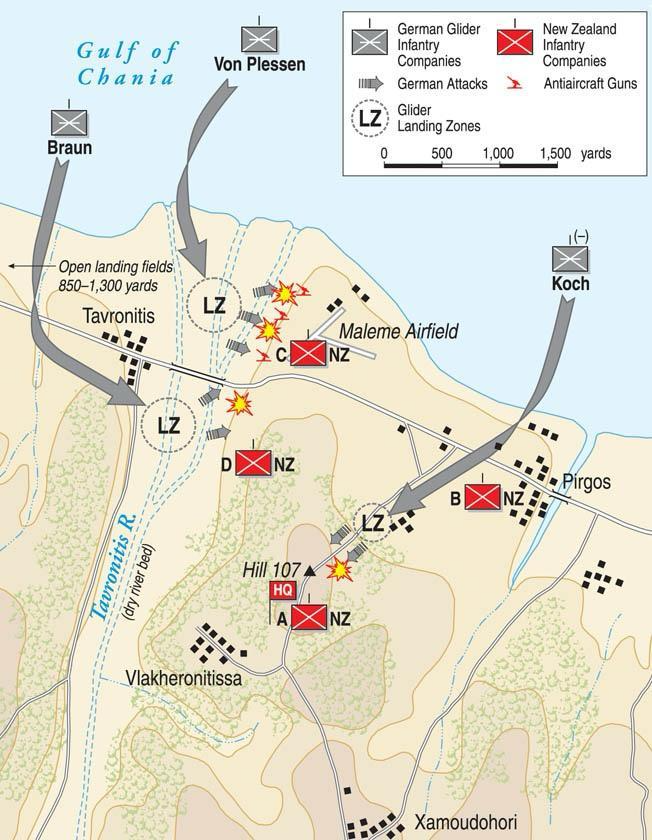
Opposing Forces
14. Student had at his disposal 315 heavy bombers and 240 dive bombers, protected by 330 fighters. To deliver his beloved Fallschirmjäger and the supporting 5th Mountain Division 502 Junkers Ju 52 transports were assigned to the operation, their standard load being 17 paratroopers and 4 equipment containers. Some Ju52s towed one of the allocated 80 gliders in the first wave, each holding a pilot plus nine other troops. Troops numbered around 22,750, including 750 glider borne men,10,000 paratroopers and 12,000 crack mountain troops.
15. To defend Crete and the vital airfields, there would be no RAF aeroplanes and just 10 Bofors anti-aircraft guns at Maleme. The entire Crete Garrison, under Major General Bernard Freyberg, mustered about 32,000 men plus between 6,000 - 10,000 Greek troops (the number cannot be agreed). However, the actual fighting strength was closer to 15,000 with possibly 5,000 more who could be used as infantry at a push. Unfortunately, the 25,000 Allied troops who had escaped from Greece had brought virtually nothing with them with which to fight. The defence of Maleme was given to the New Zealanders of 22 Battalion (Bn), 620 men in all, part of the 5th NZ Brigade under Brigadier James Hargest. Additionally, there were a handful of Army and Australian gunners, 85 Royal Marines …. and, somewhat incongruously, 133 men from 30 Squadron with 96 more from 33 Squadron!
Intelligence
16. In different ways both sides suffered poorly. The British should have held the upper hand, having cracked the German code at Bletchley Park and being able to decipher every German transmission. Major General Freyburg knew that 17 May was the original date set for the invasion, until the failure to deliver and store sufficient aviation fuel for the Luftwaffe transport aircraft saw the operation delayed by three days. Freyburg, however, had a dreadful dilemma. It was essential not to reveal to the enemy the fact that we could read their signals. He also appears to have misread “seaborne support” as a “seaborne invasion”, never knowing that that was highly unlikely if not impossible.
17. Conversely, German intelligence had grossly underestimated the strength on Crete, only increasing the perceived strength from 12,000 to 48,000 at the last minute, which probably caused some consternation to the lightly equipped Fallschirmjägers just before take-off! At Maleme, they also missed the heavily camouflaged New Zealand positions on Hill 107 despite daily ‘shufty kites’ - recce sorties - for several weeks.
The Airborne Assault
18. The regular 06:00, 12:00 and 18:00 bombing of the airfield perimeter defences had intensified during the week preceding the invasion and strafing had increased, particularly on the 19 May. Ground crew had dug pits ten feet deep to work on the aircraft but those, and slit trenches, were their only protection. Tuesday 20 May dawned brightly and promised another pleasant Mediterranean day with a clear blue sky and no breeze. At first light some 30 Squadron men, including Pilot Officer Crowther (Sqn Armaments Officer and Acting I/C), joined the New Zealanders so superbly concealed on Hill 107. Meanwhile, 33 Squadron personnel, took to their slit trenches overlooking the Tavronitis Bridge. These were, probably, within 50 metres of our memorial site, down towards the left as you look towards Tavronitis.
19. From our records we know that the daily 04:30 - 07:30 ‘Stand To’ at Maleme prior to the start of the daily German air raids, commonly referred to as the ‘Morning Hate’, was over and most airmen were wandering off to the mess tent for breakfast. So routine was all this that some men even left their rifles behind… I doubt that has ever happened since! However, the complacency is perhaps better understood from the diary of the 30 Squadron Medical Officer, Flying Officer Tom Cullen (who was to earn an MBE for his work that day and beyond). Tom stated that he had far more people reporting to him with dysentery than with injuries from bombing or strafing.
20. At 07:30 an unexpected heavy bombing raid took place, the aiming points being the ten Bofors gun emplacements around the airfield perimeter; the dirt runways were left intact. Most of the guns were out of action before 08:00, when the sky above Maleme filled with the radial engine throb of Junkers 52s as 500 of them, plus the gliders, approached at between 300 and 400 feet.
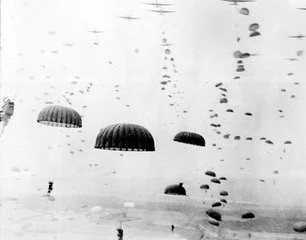
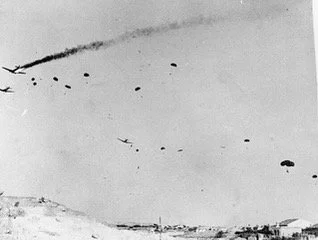
Fallschirmjaeger during the invasion, as a Ju52 enters its final descent on fire. Copyright IWM
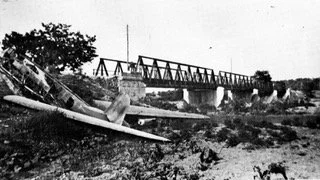
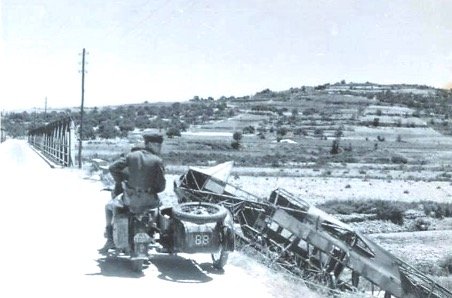
Two photos of the same glider at Tavronitis Bridge, looking east towards Hill 107. There was far less cover in 1941.
21. Major Braun’s dozen or so gliders, targeted against the Tavronitis iron bridge, led the assault, landing alongside and in the riverbed very shortly after 08:00. Three gliders landed among the olive trees and tents of the RAF accommodation area and another is famously photographed, having come to a stop on the very ramparts of the bridge. The thump of the (few) mortars; the chatter of two (RAF manned) Lewis guns and the weapons of 22 Bn C and D Coys meant that most gliders never got to disembark their men but Braun’s force did eventually succeed in capturing the bridge. Amongst their dead, however, was their leader, shot early in the fighting. One 33 Squadron airman riddled a glider that virtually landed on top of his tent … using a 22 Bn Tommy Gun that he just happened to spot leaning against a tree. It seems that the RAF weren’t the only men leaving weapons lying around!
22. At the same time, Von Plessen’s larger wave landed nearer the river mouth. They attacked the Western edge of the airfield and knocked out some of the anti-aircraft positions but, again, it cost their leader his life. The third group, targeting Hill 107 directly, included the Battalion Headquarters under Major Koch and a Company under Hauptman Sarrazin. They landed right on top of the concealed New Zealand positions of A and B Companies and the embedded 30 Squadron airmen. Inevitably, utter carnage ensued and this group suffered a massive 90% casualty rate, including both Sarrazin, who was killed, and Koch with a severe head wound. The survivors scattered and could not impact the battle until they managed to meet up with other assault units, many fraught hours later.
23. Even before the invasion had begun, fate had played its hand when Group Centre’s CO, Generalmajor Wilhelm Süssmann, and his staff were killed in an operational accident caused by turbulence from overflying Luftwaffe bombers that led to their glider’s wing detaching from the fuselage. Süssmann was meant to have commanded the attack against Chania and Souda Bay. Thus, of the two groups attacking Crete that morning, one had lost its strategic leader before even sighting the island and all three of the Maleme glider waves had lost their tactical commanders! Only Generalmajor Eugen Meindl, arriving at one of the Group West DZ, remained effective. However, he quickly realised how badly the assaults had fared and dug in on the airfield perimeter to revise the plan for assailing Hill 107 across the Tavronitis Bridge. Shortly afterwards, he too was wounded, along with his Adjutant, leaving command of the entire Maleme assault force under a relatively junior Officer, Hauptmann Walter Gericke.
24. As the gliders swooped in, the sky filled with the white chutes of the men, red chutes of section leaders and green chutes of equipment containers… plus the incessant noise of the invaders being shot at during or immediately after their descents. The few surviving Bofors guns opened up, finding low flying, slow flying transport aeroplanes an easy target. If the force landing to the West had a relatively straightforward arrival, an entire Battalion dropped right onto other unseen defensive positions to the East of Hill 107, there to face annihilation at the hands of the Kiwi 21 and 23 Bns concealed and ready.
25. If the German parachute design had a flaw, it was that, whereas the allied ‘Irvine’ parachutes were shoulder mounted, allowing a kitbag of ‘killing devices, various’ to be carried down by every man, the Germans system suspended the Fallschirmjägers from a single point in the middle of his back. This gave an alarming, face down ‘angle of dangle’ and although enabling them to jump hands-free they could only carry rifles (in the main) or sub-machine pistols, leaving them extremely vulnerable until they had recovered their equipment containers. The defending force took maximum advantage of that design flaw.
26. Other paratroops landed to the South of Hill 107 and from there they were able to form up and advance. However, they were driven back by Pilot Officer Crowther and his airmen, plus 30 assorted Kiwi troops he had found on his way to do battle! Having mopped up those invaders he then led another attack, repelling a group on the Eastern side of the hill. On the western side of Hill 107 six 33 Squadron personnel in a trench on the eastern side of the Tavronitis river, with a grandstand view of the gliders’ landing zones and the iron bridge, played their part in ensuring that the enemy action was unable to proceed in accordance with the plan! Three of the men were killed that morning, one was captured, one was evacuated while the fate of one of the men remains unknown. In his book “Unspoken Valour”, Tom Cullen soberly points out that more Germans were killed in those first 30 minutes of fighting at Maleme than they had lost in all of the previous 18 months of war.
The Battle
27. The area around the 30 and 33 Squadron memorial site was defended by D Company (Coy) of 22 Bn under a Captain Campbell. His primary task was to defend the Tavronitis Bridge. To his right was C Coy, with A Coy holding the top of the hill and B Coy, the far side. Intense fighting continued all day and D Coy certainly took heavy casualties. However, they inflicted far more in never relinquishing the lower slopes of Hill 107. Communications were always extremely difficult before becoming impossible later in the day, meaning that the higher chain of command were not operating on fact but on uncorroborated hearsay, which was often inaccurate. Assumption also failed to recognise the fighting spirit of a large bunch of angry New Zealanders, Australians, Royal Marines … and, of course, the 219 men from 30 and 33 Squadrons who were certainly earning their colours as soldiers that day!
28. Nonetheless, the attack from the West succeeded in gaining control of much of the landing area by lunchtime and, effectively, all of it by 17:00. Brutality is probably a feature of any such close quarters combat and throughout the day groups of British Commonwealth troops were rounded up and captured. Three surrendering men were witnessed summarily being executed and another group of eight airmen feared they were about to be shot, and LAC Lawrence quickly shouted out that it was illegal to execute prisoners without the authorisation of an officer. His stunned captors complied, and when an officer was found he actually agreed! However, he led the remaining eight to another group who had been captured in the sickbay and at around 14:30 this group, now numbering around forty, were made to walk ahead of an assault force up Hill 107 as a shield, loudly shouting “Don’t shoot” and suchlike. Any faltering was met with a bullet in the back. Of course, this threw the defenders into a quandary and they reluctantly pulled back. However, one group of New Zealanders led by Pilot Officer Crowther and a group of RAF men led by Corporal Harrison managed to outflank the enemy and started sniping them. In the melee, the prisoners chose to run up the hill. Many died in the attempt but at least 14 (18 in some reports) survived. The officer involved was subsequently dealt with appropriately… at Nuremberg.
29. By this time, the Field Dressing Station near the RAF camp, manned by Flying Officer Tom Cullen and Leading Aircraftsman Darch, had been overrun, and the medical staff and patients were taken to Tavronitis village where another Dressing Station was established. Tom knew he had to remain behind with the wounded but knew also that the Geneva Convention allowed for the eventual repatriation of Doctors, Medical Orderlies and Padres. As an aside, Tom was later transferred to the main POW Hospital in Athens and then to POW camps in Germany and Poland. Thoroughly annoyed that he had not been repatriated in over two years, he escaped from Stalag XX-A in Torun on 29 February 1944, hid on a coal ship bound for Sweden from whence he was eventually flown home to complete his ‘Home Run’ on 19 March.
30. Throughout the afternoon, Lieutenant Colonel Andrew, CO 22 Bn, had been imploring his Brigade HQ (a distant 6.5 kms behind the front line, unfortunately) for reinforcement from the 23 Bn Reserves. As early as 14:25, 23 Bn had heard the net exchanges and, appreciating the situation, had offered support. However, Brigadier Hargest replied that they would “… only be called upon if the situation got serious!” By 17:00, ‘serious’ was turning to ‘desperate’ around Maleme and Hill 107 and Andrew again requested a counterattack. A reply eventually came, rejecting him yet again on the (later found to be incorrect) grounds that 23 Bn were also under attack. Unable to wait for that reply, Andrew had already ordered a local counterattack, which was launched at 17:15 behind two Matilda ‘I’ tanks’ (‘I’ for infantry) which he had held in reserve.
31. Diary extracts from young German Fallschirmjägers record the fear felt by the hardpressed and tiring invaders when ‘Panzers’ were heard advancing towards them, as they lacked any weapons with which to take on a tank! Initially, the Allied counterattack achieved some success until one crew discovered that they had been issued with the incorrect calibre shells and the other tank sustained turret damage preventing the traversing of its gun. One tank then broached on a boulder on the near bank of the Tavronitis, the crew baled out into captivity. Without the armoured support, the exposed infantry had to fall back under withering fire.
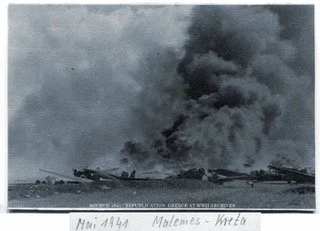
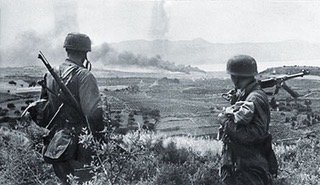
32. Brigadier Hargest did eventually send two companies forward at dusk, after Andrew had told him that he might have to withdraw his Battalion. 23 Bn heard that communication on the net and independently sent off a company to assist 22 Bn. 28 (Maori) Bn did the same, as did 21 Bn, which seems to indicate that the tactical commanders, at least, realised the threat that 22 Bn were facing. Shortly afterwards, however, communications reduced to runners between these units and Brigade HQ with even that being impossible much further forward. With comms down, battlefield management became the stuff of nightmares. 22 Bn HQ incorrectly assumed that D and C Companies at the airfield had gone silent due to being overrun. If so, the Bn was exposed to the risk of an outflanking manoeuvre on the hill. Hence, a withdrawal under darkness (in socks and with boots around the neck!) was ordered.
33. Of course, once the two companies - who were in fact perfectly capable of fighting tooth and nail - realised that they had been left isolated, they too had to fall back which gave up the airfield to the Germans. Never relishing night- time combat, they only realised their good fortune the following morning, securing the airfield before slowly advancing up the hill. Maleme airfield in German hands
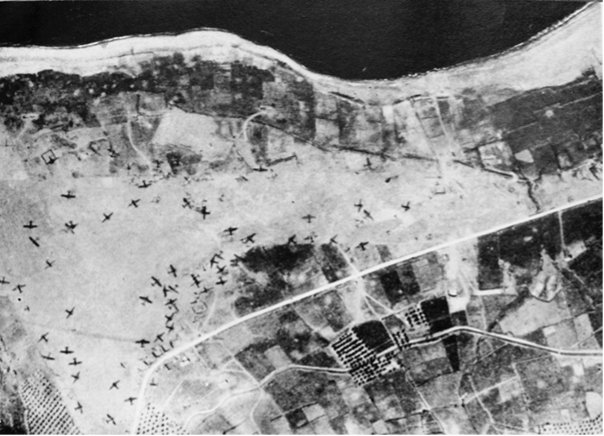
Maleme airfield in German hands
34. Sporadic engagements happened on Hill 107 for most of 21 May after a single JU 52 had landed at 04:30, then another at about 05:30 to pick up General Meindl, after which both crews reported to Athens that it was safe to land at Maleme. Student’s plan was quickly modified and 42 Ju52s dropped a company and a half of Fallschirmjägers with 37mm guns around 07:15. Flying Officer Vernon ‘Woody’ Woodward, 33’s Canadian fighter ace and senior officer after Squadron Leader Howell was seriously wounded during the morning of 20 May and assumed dead, was still in the area and recorded in his postevacuation report that a steady stream of troop carriers began to land on Maleme aerodrome and drop parachutists in the local area for the remainder of the second day and all of the following day. The unopposed Luftwaffe air bridge meant that on 22 May Generalmajor Julius Ringel and his 5th Mountain Division troops, originally allocated on Day One for Group East (Objective: Heraklion), arrived safely and the end for Crete became inevitable. On 23 May Ringel oversaw the German breakout of Maleme towards Chania and Heraklion. Chania fell on 27 May and General Freyberg issued the evacuation order that night. The story from 21-23 May onwards, heroic as it is, is beyond the scope of this material.
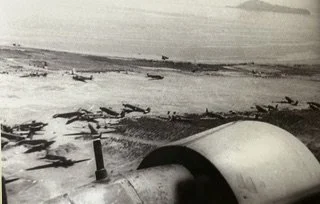
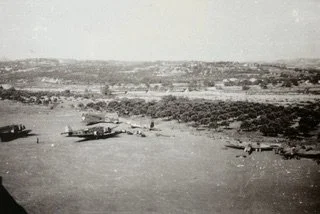
Allied and German Losses
35. Allied losses during the invasion were approximately 1,700 killed and 1,800 wounded. Over 12,000 British and Commonwealth troops were taken prisoner along with 10,000 Greeks, while 47 aircraft and 9 Royal Navy ships were lost with a further 16 badly damaged. We can never know how many Greek soldiers were killed nor the numbers of Cretan civilians; 5,000 plus is the generally mentioned figure, across the invasion period alone. The Allied dead mainly lie together in the Commonwealth War Grave cemetery at Souda Bay, looking out at the anchorage in a tearjerkingly beautiful and peaceful setting.
36. Of the 229 men of our two Squadrons who were left behind, 50 men died during that very short period. Most of them within rifle shot of where the 30 and 33 Squadron Memorial now stands. In wartime, especially, the RAF expects losses. Indeed, during WW2 entire squadrons were not infrequently lost on missions. However, in truth, the RAF never expected to lose quite so many airmen, quite so quickly and certainly not fighting as infantry. Filling a soldier’s role and sharing a soldier’s chances. 58 men more of 30 Squadron and 37 from 33 Squadron became Prisoners of War. After adventurous escapes through the White Mountains, 84 were fortunate enough to escape to Egypt, courtesy of the Royal Navy. Thirty of these were in the very last boat to leave the beach from near Sfakia.
37. For Germany, victory came at an enormous cost. Out of an assault force numbering 22,000, some 3,352 were lost within the first 48 hours. Out of a total of 5,894 Axis casualties, 4,465 Germans lie in the beautiful cemetery above the Eastern end of Maleme airfield, consisting in the main of Fallschirmjäger and Luftwaffe air crew personnel. The establishment of the cemetery in 1974 received strong support from Generalmajor Walter Gericke, who survived Crete and WW2 and commanded the Bundeswehr’s 1. Luftlande Division from 1962 to 1965. Our Memorial at Maleme stands a little more than a mile further West, in sight of some of Operation Mercury’s key objectives: the Tavronitis Bridge, Maleme airfield and Hill 107.
38. The eternal irony is that at the very point of the withdrawal from Hill 107, and even in the face of no early counter-attack (which every soldier anywhere will say is the best - if not only - way to deal with an assault from the air), the German Commanders, those very few left alive, were discussing the situation with Student on the mainland and considering either capitulation or, at least, abandoning the invasion.
39. After the Battle of Crete was over Hitler was so appalled at the losses that he forbade any further large-scale operations by the airborne forces. He awarded every survivor the Iron Cross but informed Student that the days of the paratrooper were over. Apart from certain small-scale operations, for the remainder of WW2 Fallschirmjäger units were used as highly mobile, elite infantry, ready to rush to critical, collapsing sectors on the Eastern and Western Fronts and contain Allied and Soviet breakthroughs.
The Cretan Population
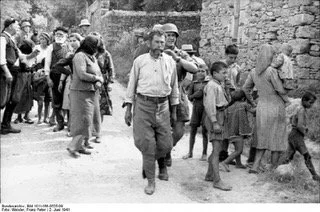
40. The content herein is focussed primarily on what befell the men of 30 and 33 Squadrons at Maleme; what happened afterwards is for other sources to record. However, the airborne invaders faced far more than the wrath of just the Kiwis, Brits and Aussies that day. Civilians taking up arms against an invading army is fraught with extreme risk; indeed, it almost guarantees execution if you are caught. Despite knowing this, the Cretan population rose up to defend their island.
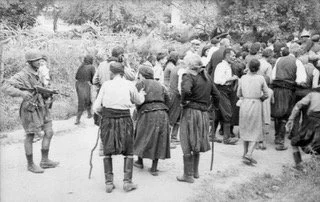
41. That resistance began in the villages around Maleme, from the moment the invasion commenced . There are apocryphal tales, which are probably best left as just that, about the treatment meted out to the Fallschirmjägers by men far above fighting age and by local women, using anything to hand as a weapon, as well as their shotguns if they owned one. One must respect and admire the aggression shown towards their unwelcome invaders, but it led to widespread brutal retaliation in the form of executions and the destruction of villages. That trend towards cruelty continued throughout the occupation, leaving deep and bitter memories which remain to this day.
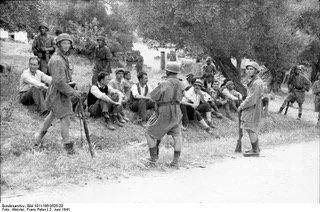
42. After the defeat, Cretans rounded up lost and missing troops and sheltered them, despite enormous risk, ahead of arranging for their rescue. Not just in ones and twos, hundreds were assisted. 300 escaped by submarine alone! Special Operations Executive (SOE) agents were dropped in to assist and organised the harrying of the German occupiers for the entire four years, tying down massive numbers of enemy troops (75 000 at its height in 1943!) from being deployed elsewhere. The 1957 film ‘Ill Met by Moonlight’ chronicles the SOE’s daring 1944 abduction, aided by the Cretan resistance, of the German officer in charge of Crete, Major General Heinrich Kreipe. The population’s utter hatred of the enemy ensured that most occupying troops were ‘extremely nervous’ at every moment until liberation finally arrived, four years and a week after the invasion.
Lae tis Kritis, oi axiomatikoi kai oi andres ton 30 kai 33 moiron se chairetoun
Which I hope reads ‘People of Crete, the Officers and men of 30 and 33 Squadrons salute you’.
Editor’s Note
None of this information stems from original research, nor do I claim any credit, except perhaps as a collator of the sometimes-contradictory information. Put that down to the fog of war or accounts written months later in other parts of the World! Neither do we seek here to lay the blame for this “defeat from the jaws of victory” on any particular individual or group. That won’t bring our chaps back…
In compiling this information, specifically for visitors to the 30 and 33 Squadron Memorial, various books and Squadron archives have been scoured. Notable but not exclusive among these are: ‘
‘Crete’ by Antony Beevor;
‘Flat Out - The History of 30 Squadron’ by John Hamlin;
‘Operation Mercury’ by Marcel Comeau MM of 33 Squadron;
‘Crete 1941’ by Howard Gerrard;
‘Unspoken Valour’ by Tom Cullen MBE.
Fact checking has been undertaken by enthusiasts from both 30 and 33 Squadrons, most notably Wing Commander (Retired) Dave Stewart. However, we can only do our best! If any details offend or are deemed inaccurate by any reader, please contact the 30 Squadron Association Secretary in the first instance, via the Association website: www.30sqnrafassoc.co.uk. The 33 Squadron Association also has a website – www.33squadronassociation.co.uk - where a number of ‘Loyalty’ newsletter articles and Battlefield Tour Guides covering the Battles of Greece and Crete, as well as the rest of the Squadron’s history since January 1916, can be accessed.